What is a Tiffin? The History of India’s Lunchboxes
If you’ve ever walked past an Indian street food restaurant and seen those gleaming, stainless steel stacked canisters, you’ve already been introduced to the tiffin. To those who are new to Indian street food, it looks like a clever bit of camping gear. But to millions of people in India, the tiffin is a cultural icon and a daily reminder of home.
No matter where in the world you are, the tiffin represents a cultural style of eating that is fresh, varied, and full of surprise. But to understand why these metal boxes are so special, we have to travel back in time to the busy and humid streets of 19th-century Mumbai.
The origins of the tiffin
The word “tiffin” actually has its roots in British India, long before it became the name for the iconic metal canisters we see today. The term is derived from the Old English colloquialism “tiffing,” which in the 1700s and 1800s meant taking a small sip of liquor or a light snack between main meals.
Over time, as the British stayed longer in India, the word evolved. It stopped being about a quick drink and started describing the lunchtime meal itself. If you were “taking tiffin,” you were sitting down for a light, easy-to-digest lunch to get you through the afternoon heat. But how did the tiffin start to make its way around the world?
The industrial boom of Bombay
In the late 1800s, the city of Mumbai (then known as Bombay) was transforming. It was quickly becoming a hub of trade and industry. As the city expanded, workers moved further from the city centre to find housing.
This created a massive problem that most big cities around the world experience: the commute. For the first time, thousands of workers were spending their entire day away from their family kitchens. While there was food available near the offices and docks, it was often bland, expensive, or simply didn’t hit the spot like a mother’s or a wife’s cooking.
For most Indian families, cooking is a strong connection to home, spice, and heritage, and not just something done to satisfy hunger. So the Indian community started working away from their homes; they didn’t want a soggy sandwich, they wanted the steam, the scent, and the soul of their own kitchen.
The invention of the tiffin
The solution to this problem was the tiffin carrier. They were designed to be the ultimate portable pantry, not just your standard, boring lunchbox that lets your food get cold and soggy.
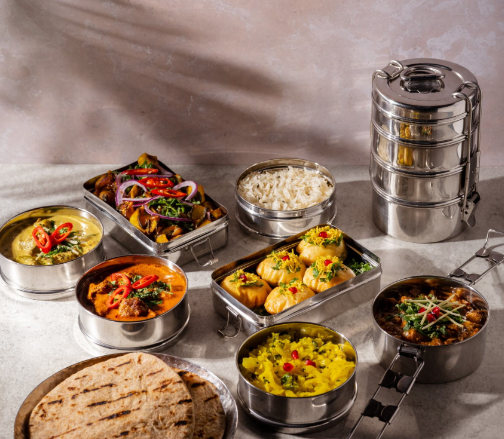
The classic tiffin is a tiered, stainless steel (or sometimes brass) system held together by a sturdy metal latch that doubles as a handle. In a hot climate, you cannot mix your food too early, or it will spoil or lose its texture, so this design served a functional purpose.
The tiered system solved a fair few lunchtime disasters:
- The bottom tier: Usually reserved for a hefty portion of rice or warm rotis.
- The middle tiers: Home to the wet dishes, the fragrant lentil dhal or spiced meat curries.
- The top tier: The place for the dry foods like crunchy salads, pickles, or a cheeky bit of something sweet.
By keeping the elements separate, the tiffin ensured the dhal didn’t make the roti soggy, and the pickles stayed crisp and punchy until the very moment the latch was unclipped at lunchtime. It was, quite literally, a multi-course meal you could carry on the handlebars of a bicycle.
A tradition that travelled the world
Today, when you walk into an Indian street food restaurant in Brighton or Liverpool, that gleaming stack of silver on your table is a direct descendant of those 19th-century Bombay lunchboxes. It represents a time when people refused to compromise on the quality of their lunch, demanding that even a meal at a desk should taste like a meal at a family table.
As these metal stacks found their way into the hearts of foodies in cities all around the UK, they challenged the Western idea of a solitary, plastic-wrapped sandwich. The tiffin taught us that lunch could be a shared experience with a puff of aromatic steam and a visual surprise. It turned the midday meal back into something more social.
How did the tiffins get delivered?
You cannot talk about the history of the tiffin without mentioning the dabbawalas. This incredible network of lunch deliverymen has been operating in India for over 130 years, and they are world-famous for their efficiency.
Every morning, thousands of dabbawalas collect freshly prepared tiffins from suburban homes. They transport them via bicycles and local trains through the chaotic heart of Mumbai, delivering them to the correct office worker by lunchtime. Once the meal is finished, they collect the empty boxes and return them to the original homes.
Come rain or shine, and even through the legendary Mumbai monsoons that bring the rest of the city to a standstill, the Dabbawalas are famously never late. They navigate the city’s streets with heavy wooden crates balanced on their bikes, each carrying dozens of metal tiffins.
There is no central computer, no GPS tracking, and no fancy app, just some hard-working people committed to getting the job done. This approach is so impressive that even when world leaders and tech moguls visit Mumbai, the dabbawalas are often the first people they want to meet. They represent a rare slice of the world where tradition and efficiency don’t just coexist, they thrive together, ensuring that the link between a home kitchen and a hungry worker is never broken.h fresh coriander and finely sliced red onion.
How is the dabbawala system so efficient?
What makes the Dabbawala system fascinating is that it operates almost entirely without technology. They use a complex system of colours and symbols painted on the tiffins to make sure that each box reaches its correct destination.
It is estimated that they make only one mistake in every six million deliveries. This level of precision has actually been studied by Harvard Business School and celebrated by royalty. It is a system built on trust, hard work, and the simple belief that everyone deserves a hot, home-cooked meal.
From the streets of India to the tables of the UK
In the UK, our relationship with lunch has often been a bit… sad, for lack of a better word. For a long time, the classic meal deal sandwich was the best we could hope for. But as the Indian street food scene began to grow in cities like Manchester and London, we started to realise that lunch could be a highlight of the day, not just a necessity.
The tiffin concept has moved from the streets of India to the vibrant neighbourhoods of major cities in the UK. People have fallen in love with the luck-of-the-draw nature of these stacked boxes. In an age where we are overwhelmed by choice, there is something incredibly freeing about letting the kitchen decide what you eat.
Why are tiffins so popular in the UK?
With the world shifting more towards healthier lifestyles, better food choices are becoming very popular. And if you’re looking for a healthy Indian food experience, the tiffin is the gold standard. Here is why this traditional lunchbox is taking over the UK:
The element of surprise: There is a specific joy in unstacking a tiffin. You never quite know what’s inside until you unclip the metal latch. It’s like a culinary Christmas morning, every single day.
Balance and variety: A tiffin isn’t just one big pile of food. The tiers allow for a balanced meal, usually consisting of a protein-rich dhal or meat dish, a vegetable side, and a portion of rice or bread.
Portion control: Traditionally, tiffins were designed to provide exactly what a person needed to get through a workday. No more, no less.
Experience the tiffin tradition at Mowgli
At Mowgli, the tiffin is the very heart of what we do. Our neighbourhood kitchen was built to capture that exact feeling of the Mumbai dabbawala delivery, the excitement of home-cooked food that is light, virtuous, and full of flavour.
When you sit down at our Indian street food restaurants and hear the clatter of the tiffin being unclipped, you are participating in a tradition that has sustained Mumbai for over a century. Our tiffins aren’t filled with heavy, greasy sauces; they are filled with the bright, zingy, and fresh flavours of an Indian home.
From the streets of Newcastle to the centre of Glasgow, Mowgli is bringing the tiffin tradition to life. We believe that lunch should be an adventure, and there is no better way to explore the world of Indian street food than by letting our chefs pack your lunchbox for you.
So, the next time you’re looking for an Indian street food restaurant that offers something a bit more soulful than your average curry, come and find us. Pull up a swing, let the fairy lights twinkle, and prepare for the luck of the draw.
Book your table at Mowgli today and unstack the magic of the tiffin!